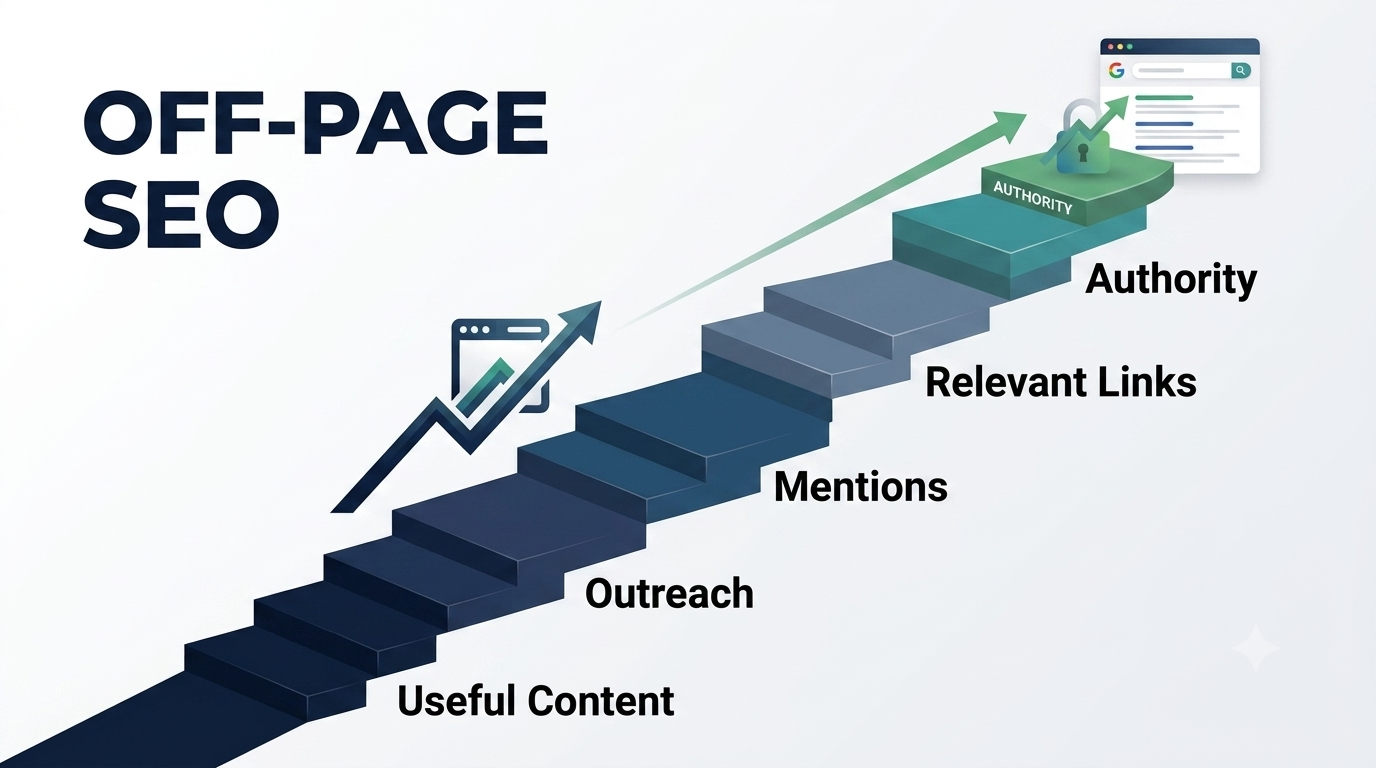
Publishing good content on your website is only part of the job. Search engines also look at signals from beyond your site to judge whether your brand is trustworthy and worth showing to searchers. This is where Off-Page SEO comes in — the activities, links, and mentions that happen outside your website but still shape how it performs in search. In this guide, you’ll learn what off-page SEO means, why it matters, which techniques genuinely help, the mistakes to avoid, and how to build a simple, ethical strategy as a beginner.
What Is Off-Page SEO?
Off-page SEO refers to everything you do away from your own website to influence how search engines and users perceive it. While on-page SEO covers what you control directly — content, titles, headings, internal links, page structure — off-page SEO is about external signals: backlinks, brand mentions, digital PR, social visibility, and general online reputation.
A simple way to think about it: on-page SEO tells search engines what your page is about. Off-page SEO tells them whether other credible sources vouch for it. Backlinks are the best-known example, but they’re not the only one. According to Google Search Essentials, creating helpful, people-first content and making pages easy to discover through crawlable links are core to how Google evaluates sites overall. No single signal guarantees rankings — off-page SEO works as a combination of trust indicators building up gradually.
Why Is Off-Page SEO Important?
Search engines can’t personally verify expertise, so they rely on external signals as proxies for credibility. When relevant, reputable sites link to or mention your content, it suggests your page is a useful resource worth ranking.
This connects to a few practical outcomes:
- Authority — built through consistent, relevant backlinks and mentions
- Trust — strengthened when credible sources associate with your brand
- Referral traffic — visitors arriving directly through external links
- Search visibility — improved standing in results over time
It’s worth being realistic: more backlinks don’t automatically mean higher rankings, and social media likes don’t guarantee visibility either. Off-page SEO supports strong content and a technically sound site — it doesn’t replace them.
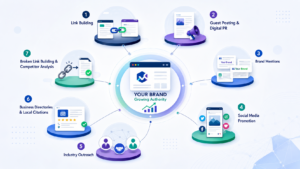
7 Important Off-Page SEO Techniques
1. Link building
Link building involves earning backlinks from other websites, ideally those related to your niche. Quality beats quantity — one editorial link from a relevant, trusted site is worth more than dozens from unrelated pages. Natural links, given because your content genuinely helped someone, are the most valuable kind.
2. Guest posting and digital PR
Guest posting means writing for another relevant site to reach a new audience and earn a contextual link — useful on legitimate, active publications, but risky on mass guest-post networks. Digital PR takes this further: sharing original research, data, or expert commentary that journalists and bloggers want to reference, often earning mentions and links without direct requests.
3. Brand mentions
References to your brand can be linked (with a clickable backlink) or unlinked (text-only). Linked mentions pass SEO value directly; unlinked ones still build recognition and can sometimes be converted into links through polite outreach.
4. Social media promotion
Shares and engagement aren’t a direct ranking factor, but social platforms help content get discovered by people who might reference or link to it later. Treat social media as distribution, not a shortcut.
5. Influencer and industry outreach
Relevant relationships with creators or experts in your niche can expand your reach. A smaller, genuinely relevant voice is usually more valuable than a large but unrelated one.
6. Business directories and local citations
Accurate, consistent listings (name, address, phone number) help local SEO. Avoid mass submissions to low-quality directories — accuracy matters more than volume.
7. Broken link building and competitor backlink analysis
Find broken links on relevant sites and suggest your content as a replacement. Separately, study where competitors earn links to spot realistic opportunities — but don’t copy every link blindly; some sources aren’t worth pursuing.
Not every technique suits every website. Choose based on your niche, resources, and what your audience actually engages with.
What Makes a Backlink High Quality?
A strong backlink usually has:
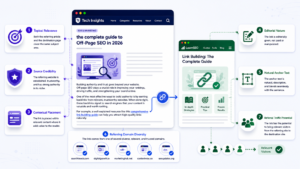
- Topical relevance to your content or industry
- Source credibility — a trustworthy, established website
- Contextual placement within the body of relevant content, not a footer or link list
- Editorial nature — earned because an editor found it genuinely useful
- Natural anchor text, not repetitive exact-match phrases
- Referring domain diversity rather than many links from the same few sites
- Potential referral traffic, since a good link often brings real visitors too
More backlinks don’t automatically mean a stronger profile. One relevant, editorially earned link can outweigh many irrelevant ones, and not every possible link is worth pursuing — some add more risk than value. Links without qualifying attributes can generally pass ranking signals, while nofollow, sponsored, and UGC links are treated differently by search engines. These links can still generate referral traffic, increase visibility, and contribute to a natural backlink profile.
Off-Page SEO vs. On-Page SEO
| On-Page SEO | Off-Page SEO |
|---|---|
| Content quality | Backlinks |
| Title tags & headings | Digital PR |
| Internal links | Brand mentions |
| Image optimization | External relationships |
| URL structure | Citations |
| Page-level user experience | Online reputation |
Neither is more important than the other. On-page SEO gives search engines a clear picture of your pages; off-page SEO shows how the wider web responds to them. Strong content generally performs best when it’s backed by credible external signals.
Common Off-Page SEO Mistakes
- Buying low-quality backlinks — often leads to penalties rather than rankings
- Participating in link schemes — reciprocal or automated link exchanges violate search engine guidelines
- Excessive exact-match anchor text — looks manipulative rather than natural
- Irrelevant guest posting — thin content on unrelated sites signals link manipulation
- Spammy directory or forum links — add little value and can hurt credibility
- Focusing only on backlink quantity — numbers without relevance rarely help
- Ignoring relevance — a link’s context matters more than its source’s size
- Expecting instant results — off-page SEO builds gradually, not overnight
How to Start Off-Page SEO as a Beginner
- Create genuinely useful content — something worth linking to in the first place.
- Identify relevant websites and audiences in your niche or industry.
- Build genuine industry relationships by engaging before asking for anything.
- Promote useful content through relevant, personalized outreach rather than mass emails.
- Monitor results and improve your strategy based on what’s actually working.
Consistency matters more than volume — a few thoughtful outreach efforts each week beat random link chasing.
How to Measure Off-Page SEO Success
Track referring domains, backlink quality, organic traffic, keyword rankings, search visibility, referral traffic, and brand mentions. Together, these show whether your efforts are building real authority or just adding noise.
Third-party metrics like Domain Authority or Domain Rating are useful for comparing your site against competitors, but they are not part of Google’s search ranking systems — search engines don’t use these proprietary scores directly. Treat them as directional benchmarks, not proof of ranking potential.
Off-Page SEO Checklist
- Create useful content
- Promote content to relevant audiences
- Build genuine industry relationships
- Earn relevant backlinks
- Monitor brand mentions
- Analyse competitor backlink opportunities
- Maintain accurate business listings where relevant
- Review your backlink profile regularly
- Avoid manipulative link-building practices
- Track organic visibility over time
Final Thoughts on Off-Page SEO
Off-page SEO isn’t about accumulating as many backlinks as possible — it’s about building genuine authority, trust, and visibility through relevant relationships and credible signals. Quality and relevance consistently outperform shortcuts and manipulation. By focusing on useful content, ethical outreach, and steady, consistent effort, you can strengthen your website’s standing in search results in a way that lasts. Off-Page SEO works best as one part of a broader, patient SEO strategy — not a quick fix.
Frequently Asked Questions About Off-Page SEO
1. What is Off-Page SEO?
It’s the set of activities outside your website — like backlinks and brand mentions — that influence how search engines view its authority and trust.
2. Why is Off-Page SEO important?
It helps search engines evaluate credibility through external signals, supporting stronger visibility over time.
3. Are backlinks still important for SEO?
Yes, but relevance and quality matter far more than raw numbers — a handful of strong links can outperform hundreds of weak ones.
4. What makes a backlink high quality?
Relevance, source credibility, editorial placement, and natural anchor text, ideally alongside potential referral traffic.
5. How can beginners start Off-Page SEO?
Start with genuinely useful content, then focus on relevant relationships and ethical, personalized outreach.
6. How long does Off-Page SEO take to show results?
There’s no fixed timeline — it depends on competition, website authority, content quality, and consistency, so results build gradually rather than overnight.
Pingback: SEO Analytics: How to Turn Search Data Into Action