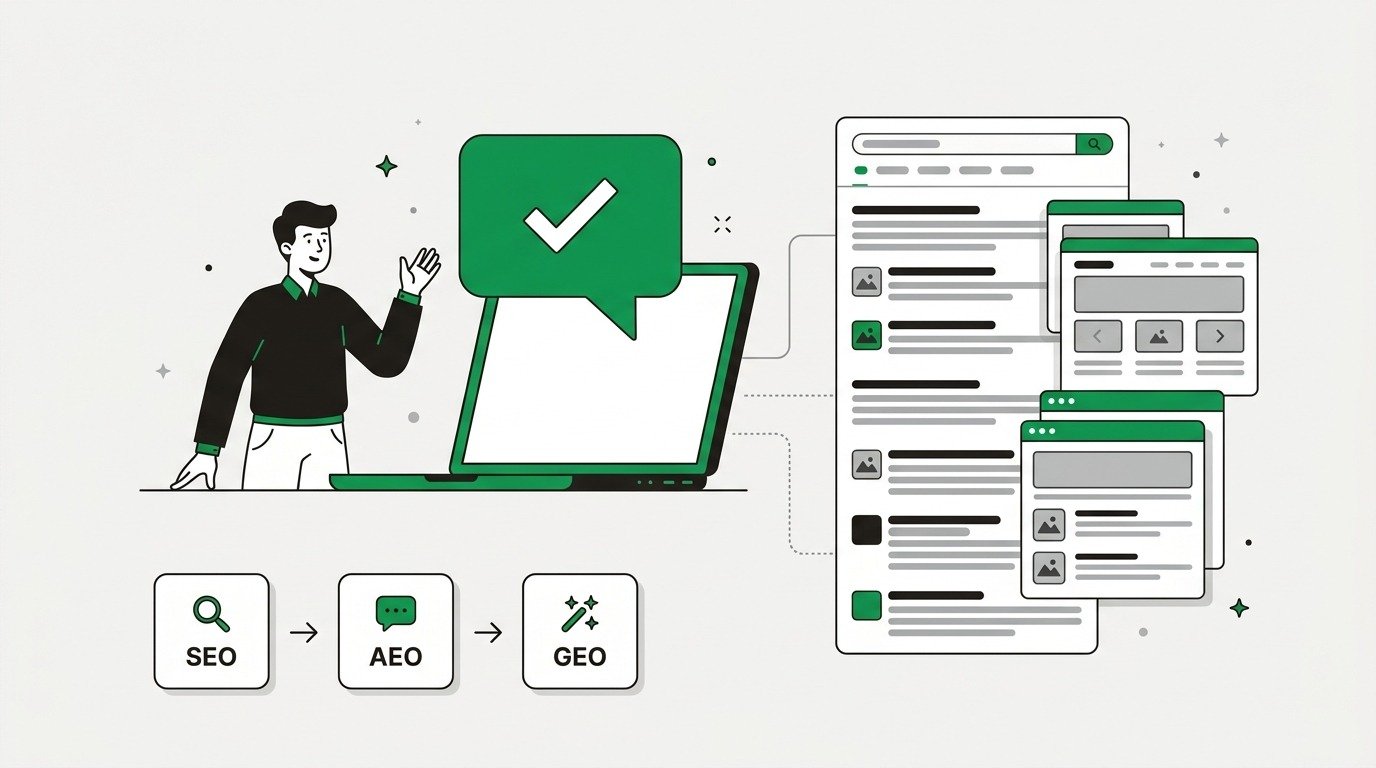
I’ll be honest with you: the first time this really hit me wasn’t while reading an SEO blog. It was while watching someone ask ChatGPT a question I’d written an entire article about. They got a clean, confident answer in three seconds. My article never came up. My name never came up. My site never came up.
Nothing was wrong, technically. The site was indexed. The SEO was solid. And yet, in that one conversation, none of it mattered.
That’s the quiet, uncomfortable shift happening right now. More people are starting conversations with “How do I rank on Google?” and ending up somewhere new entirely, asking, “How do I make sure my information is useful and findable wherever people are actually asking questions?” Sometimes that’s still Google. Increasingly, it’s ChatGPT, Perplexity, or an AI Overview sitting right at the top of a search page.
This shift has a name: AEO (Answer Engine Optimization). And understanding it doesn’t mean abandoning everything you know about SEO. It means widening the lens a little.
What Is AEO (Answer Engine Optimization)?
AEO is the practice of making your content easier for AI-powered systems to understand, retrieve, and reference when they generate answers to people’s questions rather than only optimizing for a ranked list of links.
Here’s a simple way to picture the difference. Traditional SEO is built around a results page: you’re competing for a spot in a list, and the user chooses which link to click. An “answer engine” — whether that’s Google’s AI Overviews, ChatGPT, or Perplexity — skips the list. It reads across multiple sources, pulls out what seems most useful, and hands the person a direct answer. You’re no longer just trying to earn a click. You’re trying to earn a mention inside someone else’s answer.
That’s a real shift in what “visibility” even means.
SEO vs. AEO: What’s the Difference?
SEO and AEO aren’t rival disciplines; think of AEO as SEO’s focus sharpening for a new kind of reader: a machine that has to use your content, not just link to it.
| SEO | AEO | |
| Primary goal | Rank well and earn clicks | Be understood and referenced in generated answers |
| User behavior | Scans a list of results | Reads or hears a synthesized answer |
| Content format | Optimized pages, meta tags | Clear, self-contained, retrievable sections |
| Search experience | Ranked results page | Direct, conversational answer |
| Optimization focus | Keywords, backlinks, technical SEO | Clarity, structure, trust, retrievability |
| Measurement challenges | Rankings and clicks are visible | Mentions and citations are harder to track |
Good SEO fundamentals: crawlability, clear structure, genuine usefulness still matter enormously for AEO. You’re not starting over. You’re building on the same foundation with a slightly different finish line.
What Is AI Search Optimization?
AI search optimization is the broader practice of making content clear, well-structured, and trustworthy enough that AI-powered search experiences can confidently pull from it, whether that’s Google’s AI Overviews, a chatbot, or a voice assistant.
This isn’t about gaming one universal algorithm, because there isn’t one. Different AI products synthesize information differently. What tends to help across the board is content that’s factually consistent, clearly written, backed by real expertise, and easy to lift a clean, accurate answer from. Think in terms of clear entities (people, places, products, concepts), logical relationships between ideas, and information that doesn’t require guesswork to interpret.
AEO vs. GEO SEO: Are They the Same Thing?
Honestly? The terminology here is still settling, and you’ll see marketers use these terms slightly differently depending on who’s writing.
GEO (Generative Engine Optimization) is generally used to describe optimizing for generative, AI-powered search experiences, broadly in the same territory as AEO. In practice, most people use “AEO” and “GEO” to mean largely overlapping things: making content genuinely useful and structurally clear for systems that generate answers rather than just rank links. There isn’t one universally agreed-upon line between them yet, and I’d rather tell you that honestly than invent a false distinction just to make this section feel tidier.
What matters more than the label is the underlying principle both terms point to: be the source that’s easiest to trust and easiest to use.
How Does ChatGPT Find Information?
This is worth slowing down on, because a lot of AEO advice online overstates how this actually works.
ChatGPT doesn’t have one single, simple mechanism. According to OpenAI’s own documentation, ChatGPT can search the web when a question would benefit from current information — pulling in live results and citing sources directly in its response. But it doesn’t browse the web for every single question. A lot of what it says still comes from patterns learned during training, not a live lookup.
So there’s no single “index” you can submit your site to and guarantee a mention. Different AI products like ChatGPT, Perplexity, and Google’s AI Overviews use different retrieval systems, different data sources, and different rules for when they search live versus rely on existing knowledge. Optimizing for one doesn’t automatically mean you’ve optimized for all of them.
That uncertainty isn’t a reason to give up. It’s a reason to focus on what you can actually influence.
Getting Cited by ChatGPT: What Can You Actually Control?
This is the section I wish someone had written plainly for me, instead of the vague “just optimize for AI” advice floating around.
What you can control:
- The clarity and quality of your website itself
- How clearly your content answers the actual question someone is asking
- Topical depth genuinely covering a subject, not skimming it
- Factual accuracy and consistency across your site
- Clear author and business information
- Basic technical SEO health (more on this below)
- Structured data, used accurately
- Internal linking and logical page organization
- Original insight, real experience, and credible external references
- Keeping information current when freshness genuinely matters
What you cannot guarantee:
- A specific ChatGPT citation
- A particular position in an AI-generated answer
- Appearing in every relevant AI search result
- Permanent visibility once you’re mentioned once
- A guaranteed frequency of mentions
- That an AI system chooses your page over a competitor’s

Saying this plainly: nobody can promise you a ChatGPT citation. Not me, not a paid tool, not a “GEO agency.” What you can do is remove every reasonable barrier between your genuinely useful information and the systems trying to find genuinely useful information.
How to Make Content More “Answerable”
“Answerable” doesn’t mean turning every paragraph into a robotic one-liner. It means structuring content so a real question gets a real, findable answer.
- Direct answers first. Answer the core question in the opening sentences of a section, then add depth after.
- Clear, accurate headings. A heading should describe the actual question or topic it addresses, not a vague, clever phrase.
- Concise explanations, not compressed ones. Say the answer clearly, then give the context that makes it useful, rather than stripping context away just to look shorter.
- Question-based sections where it fits naturally, mirroring how people actually phrase what they’re asking.
- Clear definitions for any term a beginner might not know yet.
- Numbered steps for anything process-based.
- Tables, used only when a genuine comparison helps.
- Concrete examples to anchor abstract ideas in something real.
This overlaps closely with what already makes content genuinely useful for readers and for search intent: what someone actually wants isn’t a new skill AEO invented. It’s the same skill, applied to a system that now reads the answer back instead of just linking to it.
Why Entities and Topical Clarity Matter
AI and search systems increasingly try to understand things people, organizations, products, places, concepts, and the relationships between them, not just strings of keywords.
You can help with this in ordinary, unglamorous ways: consistent naming of your brand and key terms across your site, a clear About page, visible author information, accurate service or location details, and internal links that connect related topics logically. None of this guarantees an AI citation on its own, but it removes ambiguity, and ambiguity is the enemy of being confidently referenced.
Building Topical Authority Without Keyword Stuffing
Genuine topical authority comes from covering a subject thoroughly across multiple, connected pieces of content, not from publishing volume for its own sake.
That might mean a cluster of articles that genuinely build on each other (the way this entire blog has moved from SEO fundamentals through keyword research, on-page elements, and content writing), original insight where you genuinely have it, and internal links that help both readers and systems understand how your ideas connect. It does not mean publishing hundreds of thin, AI-generated pages just because a keyword tool says there’s search volume. That’s not authority — it’s noise, and both readers and AI systems tend to notice.
Originality and First-Hand Experience Still Matter
If you have genuine first-hand experience, original research, or a real, specific insight, that’s some of the most valuable content you can offer to a human reader or an AI system summarizing for one.
I won’t pretend to have run a formal case study on AEO myself; I haven’t, and I’m not going to invent one just to sound more credible. What I can tell you honestly is what’s consistent across every credible source on this topic: genuine, verifiable expertise is worth far more than confident-sounding filler. If you don’t have first-hand experience with something, say so, or don’t claim it. That honesty is, ironically, part of what trustworthy content looks like.
Technical SEO Still Matters for AEO
AEO doesn’t replace technical SEO; it depends on it.
If a page isn’t crawlable, indexable, mobile-friendly, reasonably fast, and properly structured, none of the retrieval systems these AI tools rely on can even get to it in the first place. Sitemaps, clean canonicalization, sensible internal linking, and accurate structured data all still matter not because any one of them guarantees an AI citation, but because they’re the baseline that makes your content reachable at all.
What About Structured Data?
Structured data (schema markup) helps eligible systems understand what a piece of content actually represents: an article, a product, a FAQ, a how-to guide.
It’s genuinely useful and worth doing accurately. But I want to be direct here: adding schema does not mean ChatGPT will cite you. It can help eligible search systems interpret your content more reliably, which is a real, worthwhile improvement, just not a guarantee dressed up as one.
Content Formats That Can Help
Certain formats tend to translate well into clear, answerable content definitions, how-to guides, comparisons, FAQs, checklists, original research, and clear explanations of a product or local service.
The right format should follow what the reader (or the question) actually needs, not the other way around. Don’t build a comparison table because “tables help AEO”; build one because you’re genuinely comparing something worth comparing.
10 AEO Mistakes That Can Hurt Your AI Search Visibility
- Writing only for keywords, not for the actual question behind them
- Publishing generic, AI-generated content at scale with no real editorial oversight
- Copying competitors’ structure or claims instead of adding genuine value
- Giving vague, hedging answers instead of a clear, direct one
- Burying the actual answer under a long, unnecessary introduction
- Ignoring technical SEO, assuming AEO is a separate, standalone discipline
- Publishing inaccurate information, which damages trust fast and permanently
- Faking expertise or experience you don’t actually have
- Using structured data inaccurately, which can confuse more than it clarifies
- Expecting a guaranteed ChatGPT citation as if it were a purchasable outcome
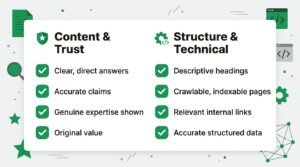
A Practical AEO Checklist
Content
- Main question clearly identified
- Search intent understood
- Direct answer provided early
- Supporting context included, not stripped away
- Genuinely original value, not a rehash
- Claims are accurate
- No unnecessary filler
Structure
- One clear H1
- Descriptive H2/H3 headings
- Short, readable paragraphs
- Lists used where genuinely useful
- Tables used only when they clarify
- Questions answered naturally, not mechanically
Trust
- Author information is clear
- Business information is accurate
- Sources cited where relevant
- Experience represented honestly
Technical SEO
- Page is crawlable and indexable
- Internal links are relevant
- Canonicalization is correct
- Sitemap is maintained
- Structured data is accurate, where used
AI Search Readiness
- Important facts are stated clearly, not buried
- Key entities are clearly identified
- Content is easy to understand at a glance
- The page offers something genuinely worth referencing
What Not to Do
Please don’t keyword-stuff, publish hundreds of low-value AI-written pages, copy competitor content, invent author credentials, buy any “ChatGPT citation package” (these are not a real, legitimate service), manipulate structured data, fabricate reviews, or strip out context just to make an answer shorter.
The goal was never to trick a system into mentioning you. It’s to become a source genuinely worth mentioning.
The Future of Search, Honestly
People are discovering information through more channels than ever — traditional search, AI assistants, AI-powered search interfaces, social platforms, maps, communities, and direct brand searches. That range will likely keep expanding, though exactly how is still an open question, not a settled fact. I’d rather tell you that plainly than pretend to know the future with more confidence than anyone actually has right now.
Coming Back to the Question
So does ChatGPT know you exist? Maybe not yet. And here’s the reframe I keep coming back to, the one that actually made this feel less scary and more useful: the real question was never “how do I force an AI to mention me?” It’s “is my content actually useful, understandable, and trustworthy enough that it deserves to be referenced?”
That’s not a new standard AEO invented out of nowhere. It’s the same standard: good SEO and, honestly, good writing, always asked of us. AEO, AI search optimization, and GEO aren’t shortcuts that replace solid SEO fundamentals. They’re an evolution of the same question I’ve been asking throughout this whole blog series: is this genuinely worth someone’s time? Traditional SEO still matters. Answer engines are just one more place that question gets asked.
Frequently Asked Questions
1. What is AEO?
AEO (Answer Engine Optimization) is the practice of making content easier for AI-powered systems to understand, retrieve, and reference when generating direct answers to user questions.
2. What is the difference between SEO and AEO?
SEO focuses on ranking well and earning clicks from a results page; AEO focuses on being clearly understood and referenced inside a generated answer. They share the same foundation and reinforce each other.
3. Is AEO the same as GEO SEO?
They overlap significantly, and the terminology isn’t fully standardized yet. Both describe optimizing for generative, AI-driven search rather than traditional ranked results.
4. How can I increase my chances of getting cited by ChatGPT?
Focus on clarity, accuracy, genuine expertise, and an answerable structure. There’s no guaranteed method, but removing barriers to understanding and trust improves your realistic chances.
5. Can anyone guarantee a ChatGPT citation?
No. Any service claiming a guaranteed AI citation should be treated with skepticism — no legitimate technique can promise a specific outcome across systems that behave differently and change over time.
6. Is AEO replacing SEO?
No. AEO is better understood as an evolution of how we think about discoverability, built on the same fundamentals SEO has always relied on.