You’ve done the keyword research, picked a solid target term, and written a long, thorough article — mentioning the keyword several times throughout. Technically, it looks optimized. But reading it back, something feels off: the sentences are stiff, the same phrase keeps popping up in awkward places, and you’re not sure a real person would actually enjoy reading it.
This is one of the most common traps in content for SEO: treating optimization as separate from good writing, instead of something that should support it. The real question isn’t just “how do I rank this page” — it’s how do you optimize content for search engines without losing the person actually reading it?
Content for SEO is writing created to help a page rank in search results while genuinely satisfying the reader’s need — combining relevant keywords, clear structure, and useful information so the content works for both search engines and real people. It’s not about repeating a keyword; it’s about answering a real question well enough that both readers and search engines recognize its value.
What Makes Content Good for SEO and Readers?
Good SEO content sits at the intersection of four things: relevance, structure, readability, and usefulness. Miss any one of these, and the content underperforms — even if the others are strong.
A page can be perfectly relevant to a keyword and still fail if it’s poorly structured or hard to read. Likewise, a beautifully written page that never actually addresses what the searcher wanted won’t perform either. The goal isn’t choosing between “writing for Google” and “writing for people” — it’s recognizing that when done well, these aren’t in conflict at all.
How Do You Write Content for SEO Without Sounding Robotic?
Start by writing the way you’d explain the topic to a real person, then refine it with SEO in mind — not the other way around.
Example — keyword stuffing vs. natural writing:
Before: “Content for SEO is important because content for SEO helps with SEO. Good content for SEO should always include content for SEO best practices.”
After: “Content built for SEO works best when it reads naturally — the keyword should support the sentence, not dictate it. A well-optimized paragraph should feel like the writer already knew the topic well, not like it was assembled around a phrase.”
Notice the second version says essentially the same thing, but reads like an actual explanation instead of a keyword container. That difference is often the entire gap between content that ranks briefly and content that keeps performing.
How Should You Use Keywords Without Keyword Stuffing?
Use your primary keyword where it naturally fits — in the title, early in the introduction, in at least one heading, and occasionally throughout the body — without forcing it into every paragraph.
Example — keyword in a natural heading:
Instead of an awkward heading like “Content For SEO Tips For SEO Content”, a more natural version reads: “How to Structure Content for SEO Without Losing Flow.“ The keyword is present, but it reads like a heading a real writer would choose.
There’s no fixed keyword density you need to hit. Google doesn’t require an exact number of repetitions — what matters is that the topic is covered thoroughly enough that natural variations of your keyword and related terms show up on their own.
How Does Search Intent Shape SEO Content?
Search intent determines what kind of content actually satisfies a searcher — whether they want a guide, a quick answer, a comparison, or a product page. Getting this wrong means even well-optimized content underperforms, since it doesn’t match what the reader was hoping to find.
Before writing, it helps to check what’s already ranking for your target keyword and confirm your content matches that expectation — a step covered in more depth in a, but worth keeping in mind as you plan any piece of SEO content.
How Should You Structure an SEO-Friendly Article?
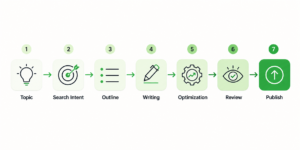
A clear structure helps both readers and search engines understand your content quickly.
- Use one H1 that includes your primary keyword
- Break sections with descriptive H2s and H3s where needed
- Keep paragraphs short — 2–4 sentences is usually enough
- Use bullet points or numbered lists for steps or options
- Include specific examples rather than only general statements
- Let ideas flow logically, rather than jumping around
This overlaps closely with the page-level choices covered in — titles, headings, and internal links all work together with your writing itself.
How Can You Make SEO Content Easier to Read?
Readability comes down to a handful of habits: shorter sentences, active voice, clear transitions, and enough white space that the page doesn’t feel overwhelming.
Example — a generic intro vs. a reader-focused one:
Generic: “In this article, we will discuss content for SEO and why content for SEO matters for your website’s success online.”
Reader-focused: “You’ve written a solid article, optimized it, and it still isn’t performing the way you expected. Here’s what’s usually missing — and how to fix it.”
The second version gets to the point and speaks to a real problem, rather than announcing what the article is about to do.
What SEO Elements Should You Optimize Before Publishing?
Before hitting publish, review the technical basics alongside your writing:
- Title tag includes your primary keyword
- Meta description accurately summarizes the value of the page
- URL is short and descriptive
- Primary keyword appears in the H1, intro, and at least one H2
- Headings are descriptive, not generic
- Internal links point to genuinely relevant pages
- Images include descriptive alt text
- The content actually covers what the keyword implies it will
Search-Engine-First Writing vs. Reader-First SEO Writing
| Search-Engine-First Writing | Reader-First SEO Writing |
|---|---|
| Repeats keywords | Uses keywords naturally |
| Prioritizes keyword density | Prioritizes relevance |
| Long, generic introductions | Gets to the point quickly |
| Focuses on word count | Focuses on usefulness |
| Generic explanations | Specific examples |
| Awkward, forced anchor text | Natural internal links |
| Writes for rankings | Writes to satisfy the query |
Common SEO Content Mistakes That Push Readers Away
- Keyword stuffing — repeating the exact phrase until it reads unnaturally
- Writing only for rankings — ignoring whether the content actually helps anyone
- Overusing headings — breaking simple ideas into unnecessary sub-sections
- Long, generic introductions — delaying the actual value of the page
- Repeating the same point — padding length without adding new information
- Ignoring search intent — answering a different question than the one being asked
- Unnatural anchor text — forcing keyword phrases into links that don’t read smoothly
- Prioritizing word count over usefulness — adding length without adding value
- Writing generic content — covering a topic so broadly it says nothing specific
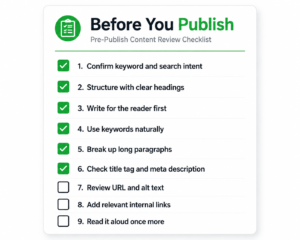
A Simple Content for SEO Checklist
- Confirm the primary keyword and search intent before writing
- Draft a clear structure with logical headings
- Write the first draft focused on answering the reader’s question
- Add the primary keyword naturally to the title, intro, and one heading
- Break up long paragraphs and add examples where helpful
- Review for repetitive phrasing or unnatural keyword use
- Check title tag, meta description, URL, and alt text
- Add relevant internal links
- Read it aloud once — if it sounds robotic, revise it
Conclusion
Writing content for SEO isn’t about choosing between search engines and real readers — it’s about recognizing that the two goals usually point in the same direction. Clear structure, natural keyword use, and genuine usefulness tend to satisfy both at once. Keyword placement alone was never the whole job; it’s simply one part of writing something worth reading. Before your next post, it’s worth revisiting one of your existing articles with this balance in mind — checking whether it reads naturally, answers the intent behind its keyword, and holds a reader’s attention from start to finish. From here, deepening your understanding of keyword research and on-page SEO will continue to sharpen how you write SEO content going forward.
Frequently Asked Questions:
1. How do you write content for SEO?
Understand the search intent behind your keyword, write naturally for a real reader first, then refine with keyword placement and structure.
2. How many times should you use a keyword in an article?
There’s no fixed number — use it where it fits naturally, typically in the title, intro, and a heading, without forcing repeated exact-match phrasing.
3. Does word count matter for SEO?
Not directly. Content should be as long as it needs to be to thoroughly answer the query — padding length without adding value doesn’t help.
4. What makes content SEO friendly?
Clear structure, natural keyword use, genuine relevance to search intent, and readability that keeps users engaged rather than skimming away.
5. How do keywords improve SEO content?
They signal relevance to search engines, helping your page match the right queries — but only when used naturally alongside useful information.
6. How do you optimize a blog post for SEO?
Confirm search intent, structure the content clearly, use your keyword naturally throughout, and review title tags and meta descriptions before publishing.