Imagine spending a week writing a detailed guide around a keyword with decent search volume, publishing it, optimizing the title, and doing everything “by the book” — only to watch it sit on page three with barely any traffic. The keyword was right. The content was well-written. So what went wrong?
Often, the answer isn’t quality or keywords at all. It’s a mismatch between what you built and what searchers were actually looking for. This gap has a name: Search Intent. Once you understand it, keyword selection, content format, and optimization decisions all start making a lot more sense.
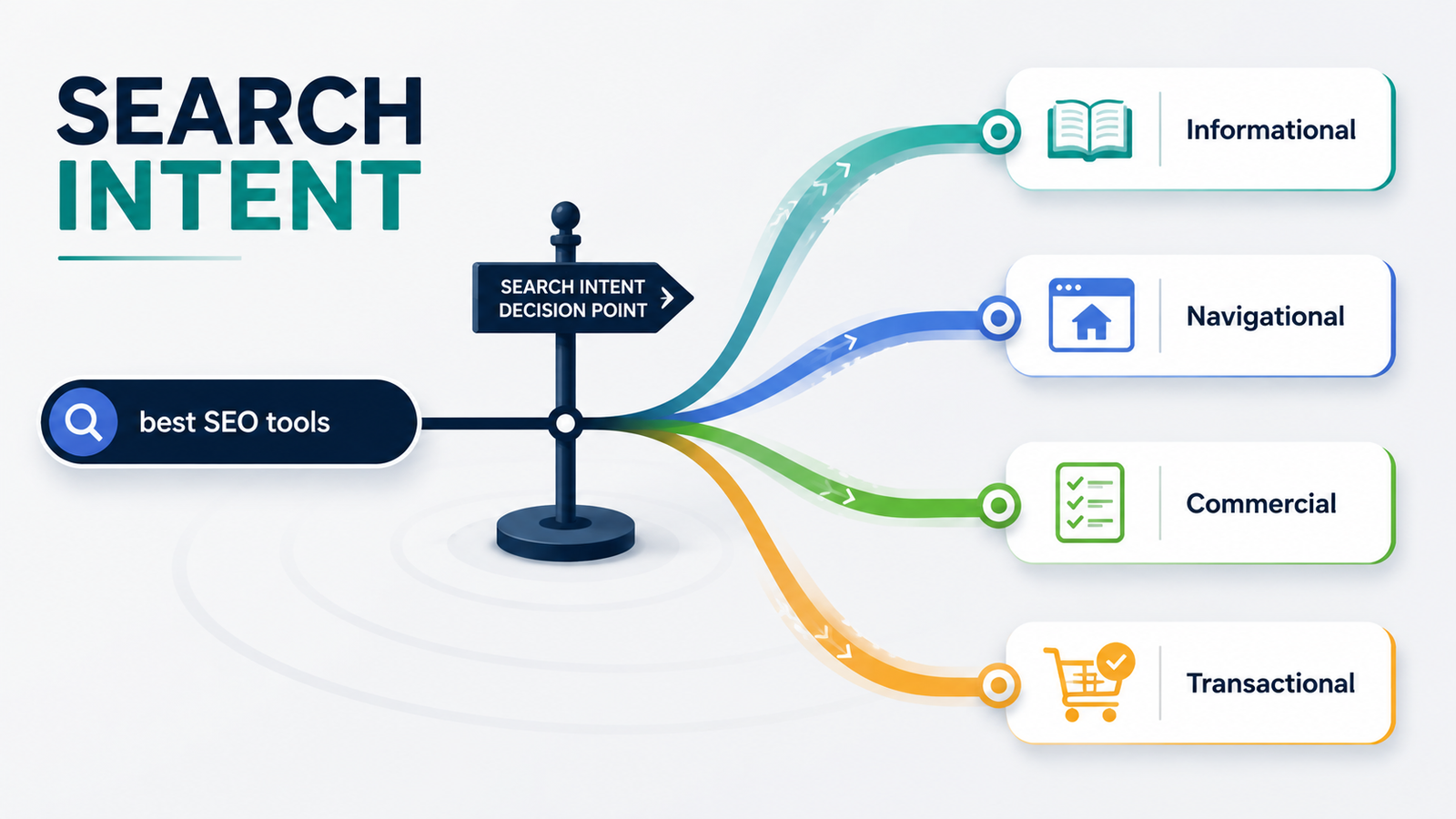
Search Intent is the reason behind a search query — what a user actually wants to find, learn, do, or buy when they type something into Google. Every search carries a goal, whether it’s answering a question, finding a website, comparing options, or completing a purchase. Understanding that goal helps you create content that genuinely satisfies the searcher, not just content that contains the right words.
Why Does Search Intent Matter for SEO?
Google’s ranking systems are built around one core aim: showing searchers the most useful result for what they’re actually trying to do. If your content doesn’t match that underlying goal, it usually won’t hold a top position for long — even with solid keyword targeting and clean formatting.
This shows up in practical, measurable ways. A mismatch typically leads to high bounce rates, low dwell time, and poor click-through rate, all of which suggest to search engines that your page didn’t satisfy the visit. Matching intent well doesn’t guarantee a top ranking on its own, but it removes one of the most common reasons content underperforms despite doing everything else “right.”
The 4 Main Types of Search Intent
Most searches fall into one of four categories. Some queries blend more than one, and intent can shift over time as user behavior changes — which is why checking the actual SERP matters more than guessing.
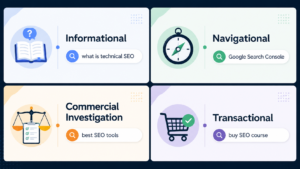
Informational Intent
The user wants to learn, understand, or find an answer. They’re not ready to buy anything yet — they want knowledge.
Examples: what is technical SEO, how does keyword research work, SEO checklist
Navigational Intent
The user already has a specific website, brand, or tool in mind and is using Google as a shortcut to get there.
Examples: Google Search Console, Semrush login, Ahrefs
Commercial Investigation
The user is comparing options before deciding. They’re closer to a decision than an informational searcher, but not ready to commit yet.
Examples: best SEO tools, Semrush vs Ahrefs, best SEO tools for beginners
Transactional Intent
The user is ready to take action — purchasing, signing up, downloading, or booking something.
Examples: buy SEO course, Semrush pricing, SEO audit service
How to Identify Search Intent for a Keyword
The fastest, most reliable way to determine intent isn’t guessing based on the keyword alone — it’s analyzing what’s already ranking. Google has effectively already done the research for you.
Here’s a simple process:
- Search the keyword on Google.
- Look at what types of pages are ranking — guides, product pages, tool homepages, comparison lists.
- Check the dominant content format (long-form article, short definition, video, listicle).
- Read the titles and meta descriptions of top results.
- Note any SERP features present (featured snippets, “People Also Ask,” shopping results, local packs).
- Identify the underlying need those pages are addressing.
- Confirm the dominant intent before you start writing.
Example 1: Search “best SEO tools” and you’ll mostly find comparison articles and roundup lists — a clear signal of commercial investigation intent.
Example 2: Search “Google Search Console” and the top result is almost always Google’s own product page — strong navigational intent.
Example 3: Search “how does keyword research work” and you’ll see explainer guides and educational blog posts dominating — informational intent, even though “keyword research” sounds like it could relate to tools or services.
How to Match Content With Search Intent
Once you know the intent, the content format should follow naturally. Creating the wrong format — a product page for an informational query, or a dense guide for someone ready to buy — is one of the fastest ways to underperform even with a relevant keyword.
| Search Intent | Example Query | Suitable Content |
|---|---|---|
| Informational | “what is technical SEO” | Educational guide |
| Navigational | “Google Search Console“ | Brand or product page |
| Commercial | “best SEO tools” | Comparison or list article |
| Transactional | “buy SEO course” | Product or service page |
Search Intent vs. Keywords: What’s the Difference?
A keyword is simply the word or phrase someone types into a search engine. Search Intent is the reason behind that phrase — the actual goal the person is trying to achieve.
For example, “SEO tools” as a keyword could mean several different things: someone wanting a definition (informational), someone comparing platforms (commercial), or someone ready to sign up for one (transactional). The keyword alone doesn’t tell you which — only checking the SERP does. This is why [INTERNAL LINK: keyword research → “What Is Keyword Research? Everything a Beginner Needs to Know”] and search intent work best as a pair, not as separate steps.
Common Search Intent Mistakes
- Choosing keywords without checking the SERP. Instead, always verify intent before committing to a content format.
- Assuming every keyword is purely informational. Instead, test each keyword individually — many carry mixed or commercial signals.
- Creating the wrong content format. Instead, match your format to what’s already ranking successfully.
- Ignoring commercial investigation intent. Instead, recognize comparison-stage searchers as a real, valuable audience.
- Optimizing for a keyword without understanding the actual need. Instead, ask what problem the searcher is trying to solve.
- Copying a ranking page’s format without improving it. Instead, use it as a baseline, then add genuine value.
- Treating intent as fixed. Instead, recheck periodically, since SERPs and behavior shift over time.
Search Intent Optimization Checklist
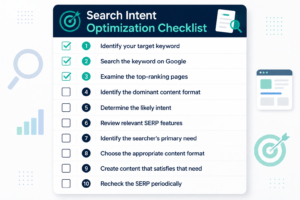
- Identify your target keyword
- Search the keyword on Google
- Examine the top-ranking pages
- Identify the dominant content format
- Determine the likely intent
- Review relevant SERP features
- Identify the searcher’s primary need
- Choose the appropriate content format
- Create content that satisfies that need
- Recheck the SERP periodically
Conclusion
Search Intent is ultimately about understanding the goal behind a search, not just the words used to express it. A keyword tells you what someone typed; intent tells you why they typed it — and that difference shapes everything from content format to structure to optimization. Before creating or updating any page, take a few minutes to check the SERP, study what’s already working, and match your content format to the dominant intent. Satisfying the searcher should always come before chasing rankings — the rankings tend to follow when the content genuinely helps. With search intent in place, the next natural step in building a complete SEO foundation is measuring whether your content is actually working — which is exactly what SEO Analytics and Google Search Console help you do.
Frequently Asked Questions About Search Intent
1. What is Search Intent in SEO?
Search Intent is the underlying goal behind a search query — what the user actually wants to find, learn, do, or buy. Understanding it helps you build content that matches real user needs rather than just targeting keywords.
2. Why is Search Intent important for SEO?
Search engines aim to satisfy the searcher’s actual goal, not just match keywords. Content that ignores intent often struggles with engagement and rankings, even when it’s well-written and properly optimized.
3. How do I identify Search Intent?
Search the keyword on Google and study what’s already ranking — the content format, headline style, and SERP features usually reveal the dominant intent clearly.
4. What are the four types of Search Intent?
Informational, navigational, commercial investigation, and transactional. Each represents a different stage in the searcher’s journey, from learning to buying.
5. How does Search Intent affect content creation?
It determines the right format and depth for your content — whether that’s a guide, a comparison list, a product page, or a brand homepage.
6. What is the difference between keywords and Search Intent?
A keyword is the phrase someone searches. Search Intent is the reason behind that phrase — the actual goal driving the search.
7. Can a keyword have more than one Search Intent?
Yes. Some keywords carry mixed or evolving intent, which is why checking the current SERP matters more than assuming intent based on the keyword alone.
How can I optimize content for Search Intent? Match your content format to what’s already satisfying searchers on the SERP, address the specific need directly, and revisit your content periodically as intent can shift.
Pingback: How to Write Content for SEO Without Losing Readers
Pingback: AEO Explained: Why ChatGPT Doesn't Know Your Brand Exists