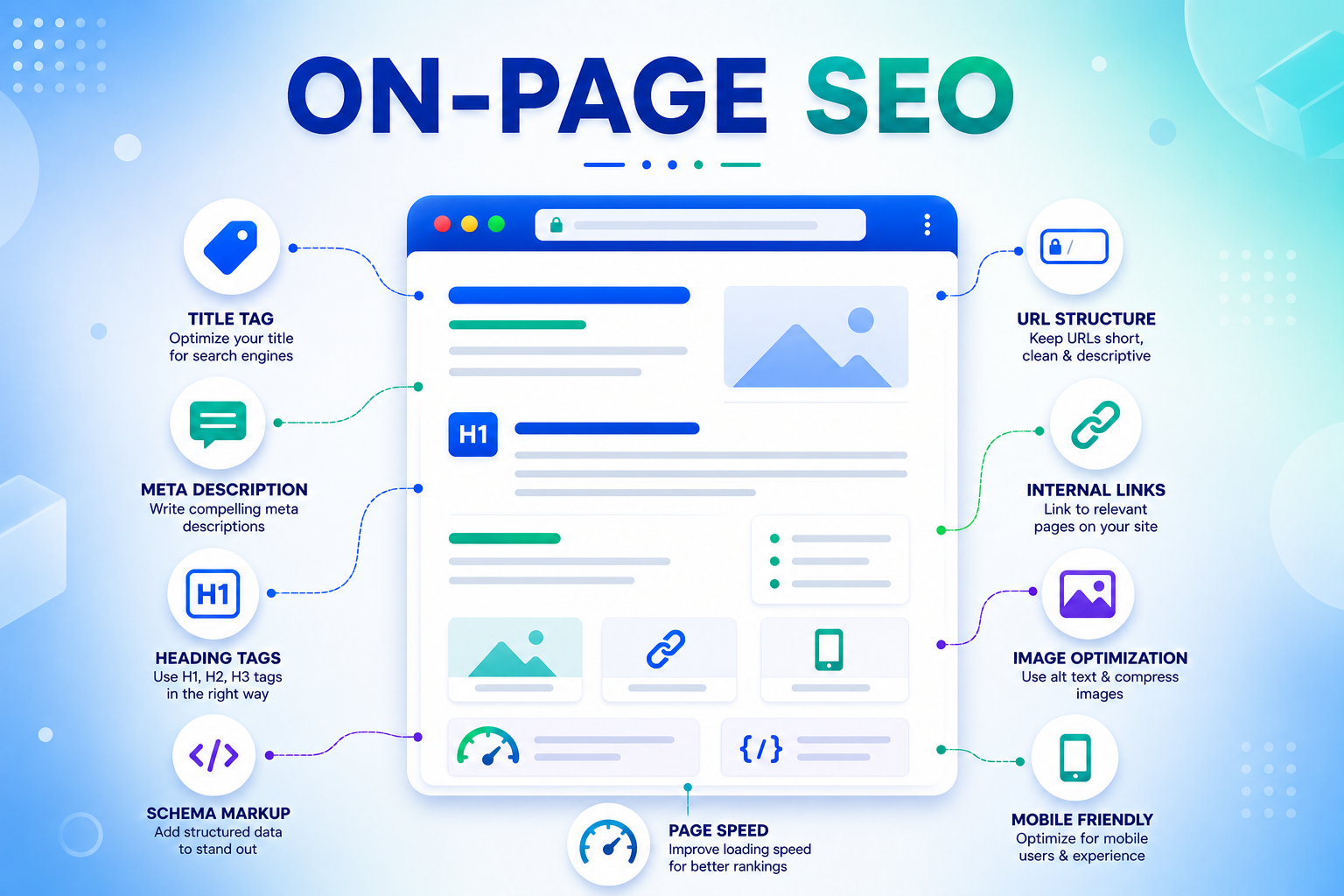
Publishing a website is exciting, but attracting visitors from Google is often the real challenge. Many beginners create valuable content yet struggle to rank because their pages aren’t properly optimized. On-Page SEO is the practice of optimizing individual webpages so they are easier for both search engines and users to understand. It improves search visibility, enhances user experience, and helps your content rank for relevant queries.
Why Is On Page SEO Important?
On-Page SEO is important because it helps search engines understand your content while improving the experience for your visitors. It helps Google interpret your webpage, supports crawling and indexing, and increases your chances of appearing in relevant search results.
- Improves search visibility
- Helps Google understand your content
- Enhances user experience
- Supports crawling and indexing
- Increases organic traffic
- Strengthens your overall SEO strategy
How Does On-Page SEO Work?
On-Page SEO works by helping search engines crawl, understand, and evaluate the content on your webpage. Googlebot crawls your webpage and evaluates signals such as title tags, headings, content quality, keyword placement, internal links, images, URL structure, page speed, and mobile friendliness. These signals help Google understand your content and determine whether it satisfies a user’s search intent.
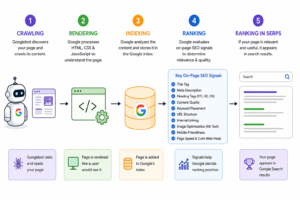
Although On-Page SEO alone doesn’t guarantee high rankings, it provides a strong foundation for long-term SEO success.
Did You Know?
Google uses hundreds of ranking signals to evaluate webpages, but many of the factors you can directly control—such as title tags, headings, content quality, internal links, page speed, and mobile friendliness—are all part of On-Page SEO.
10 Essential On Page SEO Elements
Below are the most important On-Page SEO elements every beginner should understand before publishing a webpage.
1. Understand Search Intent
Before writing a single paragraph, ask yourself: ‘Why is someone searching for this topic?’ This is known as search intent. Generally, searches fall into four categories:
- Informational
- Navigational
- Commercial
- Transactional
If someone searches for “how to optimize a webpage for SEO,” they’re looking for practical guidance—not a sales pitch.
Matching your content to the correct search intent is one of the most effective On-Page SEO techniques because it helps satisfy both readers and search engines.
2. Write High-Quality, Helpful Content
High-quality content is original, accurate, helpful, and written to satisfy a user’s search intent. Google rewards content that answers questions clearly and provides genuine value. Helpful content should:
- Answer the reader’s questions clearly
- Provide practical examples
- Use simple language
- Be well organized
- Stay accurate and up to date
For instance, rather than simply saying “optimize your images,” explain how to do it and why it improves both page speed and user experience. Small additions like these make your content more valuable and trustworthy.
3. Optimize Your Title Tag and Meta Description
Your title tag is often the first thing users notice in Google Search results, making it one of the most influential On-Page SEO factors. A strong title should:
- Include the primary keyword naturally
- Clearly describe the page
- Encourage users to click
- Stay within approximately 50–60 characters
The meta description doesn’t directly improve rankings, but it can increase click-through rates by giving users a clear summary of what they’ll find on the page.
Example:
| Element | Poor Example | Better Example |
|---|---|---|
| Title Tag | SEO Guide | On-Page SEO Made Simple: 10 Essential Elements |
| Meta Description | Learn SEO. | Learn On-Page SEO with 10 practical optimization techniques for beginners. |
4. Create an SEO-Friendly URL Structure
A well-structured URL helps both users and search engines understand what a page is about before they even open it. Although URLs are a relatively small ranking factor, keeping them clean and descriptive is one of the easiest On-Page SEO best practices to implement.
A good URL should:
- Be short and easy to read.
- Include the primary keyword where appropriate.
- Use hyphens (-) instead of underscores (_).
- Avoid unnecessary numbers, dates, or special characters.
5. Use Heading Tags Properly (H1, H2, and H3)
Headings organize your content into logical sections, making it easier for readers to scan and for search engines to understand your page structure.
A simple hierarchy looks like this:
- H1: Main page title (only one per page)
- H2: Main sections
- H3: Subtopics under each H2
Avoid using headings only for styling. Instead, use them to create a clear content hierarchy and naturally include relevant keywords where appropriate.
6. Place Keywords Naturally
One of the biggest mistakes beginners make is adding the same keyword repeatedly throughout an article. Instead, focus on natural keyword placement. Your primary keyword should appear in important locations such as:
| Recommended Placement | Avoid |
|---|---|
| Title | Keyword stuffing |
| Introduction | Repeating the keyword every sentence |
| One H2 | Forced keyword insertion |
| Conclusion | Unnatural wording |
You should also use related phrases and semantic keywords to help search engines better understand the topic. Writing naturally is far more effective than trying to achieve a specific keyword density.
7. Improve Internal and External Linking
Links provide context and help users discover additional useful information. Internal links connect readers to other relevant pages on your own website, while external links point to trusted sources that support your content.
For example, this article could naturally link to:
- What Is SEO in Digital Marketing? (to understand SEO fundamentals)
- What Is Keyword Research? Everything a Beginner Needs to Know (to learn how keywords influence On Page SEO)
Authoritative external resources such as Google Search Central can also help readers explore SEO concepts in greater depth.
8. Optimize Images for Better Performance
Images make content more engaging, but they should also be optimized. Good image optimization includes:
- Using descriptive file names.
- Adding meaningful alt text.
- Compressing images to reduce file size.
- Choosing modern formats such as WebP where possible.
For example, instead of naming an image IMG001.jpg, use on-page-seo-checklist.webp. This improves accessibility while helping search engines understand the image.
9. Focus on Mobile Friendliness and Page Speed
Most users browse websites on mobile devices, so your pages should perform well on every screen size. A fast, mobile-friendly website improves both user experience and SEO. Consider these best practices:
- Use responsive design.
- Compress images.
- Minimize unnecessary scripts.
- Improve loading speed.
- Monitor Core Web Vitals regularly.
Even the best content may struggle to rank if users leave because the page loads too slowly.
Did You Know?
Most Google searches now happen on mobile devices. A slow or poorly optimized mobile experience can increase bounce rates and reduce user engagement, making mobile optimization an important part of On-Page SEO.
10. Keep Your Content Fresh
SEO isn’t a one-time task. As search trends change, your content should evolve too. Regularly review your pages to:
- Update outdated information.
- Add new examples.
- Improve readability.
- Refresh statistics.
- Expand sections that need more detail.
Keeping content fresh signals that your page remains useful and relevant over time.
Quick On-Page SEO Checklist
Before publishing any webpage, make sure you’ve completed this checklist:
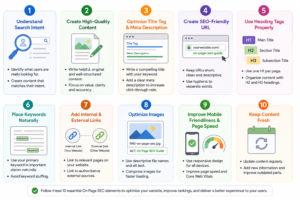
- Match your content to the correct search intent.
- Write helpful, original content.
- Optimize the title tag and meta description.
- Create a clean, descriptive URL.
- Use a proper heading hierarchy (H1–H3).
- Place keywords naturally without stuffing.
- Add relevant internal and external links.
- Optimize images with descriptive alt text.
- Ensure the page is mobile-friendly and loads quickly.
- Review and update your content regularly.
Conclusion
In summary, On-Page SEO is the process of optimizing individual webpages so they are easier for search engines to understand and more useful for visitors. By focusing on search intent, high-quality content, proper HTML structure, keyword placement, internal linking, image optimization, and page performance, you create a strong foundation for long-term organic growth. Start by optimizing one page at a time, then build on your skills as you grow. To deepen your understanding, explore our guides on What Is SEO in Digital Marketing? and What Is Keyword Research? Everything a Beginner Needs to Know.
Frequently Asked Questions (FAQs)
1. What is On-Page SEO?
On-Page SEO is the process of optimizing individual webpages to help search engines understand their content and improve their visibility in search results. It includes optimizing content, headings, title tags, URLs, images, internal links, and user experience to improve rankings and attract relevant organic traffic.
2. Why is On-Page SEO important?
On-Page SEO is important because it makes your webpages easier for both search engines and users to understand. Proper optimization improves search visibility, supports crawling and indexing, enhances user experience, and increases the likelihood of ranking for relevant keywords. It also provides a strong foundation for your overall SEO strategy.
3. What are the most important On-Page SEO factors?
The most important On-Page SEO elements include search intent, high-quality content, title tags, meta descriptions, heading structure, keyword placement, URL optimization, internal linking, image optimization, mobile friendliness, and page speed. Together, these elements help search engines interpret your content while improving the experience for your visitors.
4. How often should I update my On-Page SEO?
You should review and update your On-Page SEO regularly, especially when search trends, user behavior, or your content changes. Refreshing outdated information, improving readability, fixing broken links, updating images, and adding new examples help keep your pages relevant and competitive in search results.
5. Is On-Page SEO enough to rank on Google?
No. On-Page SEO alone is not enough to guarantee high rankings. It should be combined with Technical SEO, high-quality backlinks, strong website authority, and content that satisfies user intent.
Pingback: What Is SEO in Digital Marketing? Easy Complete Guide (2026)