
Have you ever spent hours writing a blog post only to realize that almost nobody is reading it? It’s a frustrating experience, especially when you’ve put time and effort into creating valuable content. In many cases, the problem isn’t the quality of the article—it’s choosing a topic that people aren’t actively searching for.
This is exactly where keyword research becomes essential. Before writing any blog, creating a landing page, or launching a website, understanding what your audience is searching for helps you create content that matches their needs. Whether you’re a blogger, digital marketing student, website owner, or someone starting a career in SEO, learning keyword research is one of the most valuable skills you can develop.
What Is Keyword Research?
Keyword research is the foundation of every successful SEO strategy. It involves identifying the search terms your target audience uses on search engines like Google and understanding the intent behind those searches.
Instead of guessing what people might search for, keyword research relies on real search data to uncover topics with genuine demand.
For example, imagine you own a fitness blog.
You may want to write an article titled: “Best Home Exercises”
However, keyword research may reveal that people search more frequently for:
- Home workout for beginners
- Full body workout at home
- No equipment workout
By targeting the phrases people are actually searching for, your content has a much better chance of appearing in search results and attracting organic traffic.
In simple terms, keyword research helps answer one important question: “What information are people actively looking for online?”
Once you know the answer, you can create content that meets their expectations.
Why Is Keyword Research Important?
Many beginners assume that writing great content is enough to rank on Google. While high-quality content is essential, it won’t perform well if nobody is searching for the topic.
This highlights the importance of keyword research. It helps you understand what your audience needs before you start writing, allowing you to create content with a clear purpose.
Some of the biggest benefits include:
- Finding topics with real search demand.
- Understanding your audience’s search intent.
- Increasing the chances of ranking on Google.
- Attracting consistent organic traffic.
- Creating content that answers users’ questions.
- Planning a long-term SEO strategy.
A Simple Example :
Imagine two bloggers write an article about smartphones.
Blogger A writes: “My Thoughts on Smartphones in 2026”
Blogger B researches keywords first and writes: “Best Budget Smartphones Under ₹20,000”
Even if both articles are well written, Blogger B is far more likely to receive search traffic because the topic aligns with what users are actively searching for.
This demonstrates why keyword research should always come before content creation.
How Keyword Research Helps in SEO and Digital Marketing
Keyword research plays an important role not only in SEO but also in digital marketing as a whole.
In SEO, it helps search engines understand what your content is about, making it easier to match your pages with relevant user searches.
In digital marketing, keyword research influences multiple channels, including:
- Content marketing
- PPC advertising
- Email marketing
- YouTube SEO
- Local SEO
- E-commerce optimization
By understanding user search intent, businesses can create content that reaches potential customers at different stages of their journey—from learning about a topic to making a purchase decision.
This is why professionals consider keyword research one of the first steps in building a successful digital marketing strategy.
Types of Keywords You Should Know
Understanding what is keyword research becomes much easier when you learn the different types of keywords.
| Keyword Type | Description | Example | Best Use |
|---|---|---|---|
| Short-tail Keywords | Broad search terms with high competition | SEO | Building topic awareness |
| Long-tail Keywords | More specific phrases with clearer intent | What is keyword research | Targeting beginners and niche audiences |
| Informational Keywords | Users seeking knowledge | How to do keyword research | Educational blog posts |
| Navigational Keywords | Users looking for a specific website or brand | Google Search Console | Finding a particular website |
| Commercial Keywords | Users comparing products or services | Best keyword research tools | Product comparisons |
| Transactional Keywords | Users ready to take action | Buy SEO course online |
Sales and conversions |
Instead of targeting only broad keywords, beginners often achieve better results by focusing on long-tail keywords because they usually reflect more specific user intent and can be less competitive.
How to Do Keyword Research
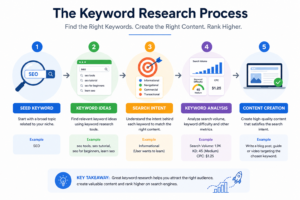
Now that you understand what is keyword research, let’s look at the step-by-step process you can follow to find valuable keywords for your website or blog.
Step 1: Choose a Seed Keyword
Start with a broad topic related to your niche, such as SEO, Keyword Research, or Technical SEO. This is called a seed keyword and serves as the foundation for discovering more keyword ideas.
Step 2: Understand Search Intent
Before selecting a keyword, identify why users are searching for it. Are they looking to learn, compare options, or make a purchase? Matching your content with the correct search intent improves your chances of ranking.
Step 3: Use Keyword Research Tools
Use tools like Google Autocomplete, Google Keyword Planner, Google Trends, Ahrefs Free Keyword Generator, or Semrush to discover related keywords and evaluate their search volume and competition.
Step 4: Choose the Right Keyword
Look for keywords that have:
- Relevant search intent
- Good search volume
- Manageable keyword difficulty
- Strong relevance to your content
A Real Example of Keyword Research
Imagine you own a bakery in Kolkata and want to attract local customers through Google. Instead of targeting a broad keyword like cake, keyword research may reveal more specific searches such as birthday cakes in Kolkata or eggless birthday cake in Kolkata. These long-tail keywords have clearer search intent and are more likely to attract people looking for exactly what you offer.
The same principle applies to SEO. Rather than targeting a broad keyword like SEO, this article focuses on what keyword research is, making it more relevant for beginners.
Best Free Keyword Research Tools
| Tool | Best For |
|---|---|
| Google Autocomplete | Keyword ideas |
| Google Keyword Planner | Search volume |
| Google Trends | Trending topics |
| Google Search Console | Performance insights |
| Ahrefs Free Keyword Generator | Keyword suggestions |
| Semrush | Advanced keyword research |

Tip: Beginners can start with free tools and switch to premium tools as their SEO skills grow.
Common Keyword Research Mistakes
- Targeting only high-volume keywords — New websites cannot compete with established sites for high-volume terms. Start with long-tail keywords that have lower competition.
- Ignoring search intent — Even if your keyword has high volume, ranking for it is useless if your content does not match what the user actually wants.
- Writing before doing keyword research — Creating content without research is like driving without a destination. You waste time on topics nobody is searching for.
- Stuffing too many keywords into one article — Keyword stuffing confuses Google and makes your content unreadable. Focus on one primary keyword per article.
Conclusion
Keyword research is more than just finding popular search terms—it’s about understanding your audience and creating content that answers their questions. By learning how to identify the right keywords, analyze search intent, and use reliable keyword research tools, you’ll build a stronger foundation for your SEO strategy and improve your chances of attracting consistent organic traffic.
Now that you understand what is keyword research, you’re ready to start finding the keywords your audience actually searches for.
To strengthen your understanding of SEO, you can also read our guide on “What Is SEO in Digital Marketing?” where we explain the fundamentals of search engine optimization and how keyword research fits into a successful SEO strategy.
Frequently Asked Questions (FAQs)
1. What is keyword research and why is it important?
Keyword research is the process of finding the words and phrases people use when searching on Google and other search engines. It helps you understand your audience’s search intent so you can create relevant content. Effective keyword research improves your chances of ranking higher in search results, attracting qualified organic traffic, and building a successful SEO strategy.
2. What is an example of keyword research?
A simple example of keyword research is starting with a broad topic like “cakes” and using tools such as Google Autocomplete or Google Keyword Planner to discover more specific searches like “birthday cakes near me” or “eggless birthday cakes.” These insights help you create content that matches what people are actively searching for.
3. Can I do keyword research for free?
Absolutely. Several free keyword research tools can help you get started, including Google Autocomplete, Google Keyword Planner, Google Trends, Google Search Console, and Ahrefs Free Keyword Generator. These tools provide valuable keyword ideas without requiring a paid subscription.
4. What are the four main types of keywords?
The four common types of keywords are:
- Informational – Users want to learn something.
- Navigational – Users are looking for a specific website or brand.
- Commercial – Users are comparing products or services before making a decision.
- Transactional – Users are ready to take an action, such as making a purchase or signing up.
Understanding these keyword types helps you create content that aligns with user intent.
5. What is the 80/20 rule of SEO?
The 80/20 rule in SEO means that 80% of your organic traffic typically comes from just 20% of your content. This is why keyword research matters — identifying and targeting the right keywords allows you to focus your efforts on the 20% of content that will drive the majority of your results.
6. How often should I perform keyword research?
Keyword research is not a one-time task. It’s a good practice to review and update your keyword strategy regularly, especially when publishing new content, tracking search trends, or expanding your website into new topics.


I like that you emphasized search intent instead of focusing only on search volume, because understanding why someone is searching usually leads to more useful content. One thing that also helps beginners is revisiting keyword research after a post has been published, since search trends and the queries bringing visitors to a page can change over time.
Pingback: SEO Analytics: How to Turn Search Data Into Action
Pingback: Search Intent Decoded: 4 Powerful Types Explained